

Meta Ads CPM inflation Q4 can turn every first sale into a loss, and you have until November 16 to stop it.
Meta’s price per ad is already up 14%, and a store that keeps spending on last quarter’s numbers pays that rise out of its own margin. A store that fixes its break-even CPA now keeps both the profit and the customer.
Quick Summary:
Meta Ads CPM inflation Q4 is already here, and the fix is margin math, not a lower CPM. Meta’s average price per ad rose 14% in Q3 2026 while impression growth slowed to 10%, and prices in the US and Canada rose 23%. This guide shows how to find your break-even CPA, decide what to change at each CPM level, and run Black Friday without rebuilding your account.
- Meta’s price per ad is growing faster than its ad impressions, and US prices are rising faster than the global rate.
- CPA stayed flat across CPM tiers in a 12-brand agency study, so judge ads on CPA, not CPM.
- In our worked example, a 20% CPM rise is covered by an 8% rise in average order value.
- A few ads take most of the spend, so ship 8 to 10 new ads a week.
- Every budget increase carries a 5% to 6% CAC penalty, so finish your last big increase by November 16.
- Advantage+ Shopping is now Advantage+ Sales, and the inputs you feed it matter more than its toggles.
What is CPM inflation on Meta?
CPM inflation is a rise in the price of 1,000 ad impressions over time. It happens when more advertisers bid for the same inventory, or when Meta sells fewer impressions against the same pool of demand. You feel it as the same budget buying less reach, even when your ads have not changed.
How much are Meta ad costs rising before Q4 even peaks?
Meta ad prices are already rising at double-digit rates, and Meta has not published a Q4 forecast. Meta’s average price per ad rose 14% year over year in its third-quarter 2026 results, up from 12% in Q2. Over the same stretch, impression growth slowed from 14% to 10%. Prices are growing faster than the supply of ad space, and that gap is the pressure you feel in the auction.
| Quarter | Average price per ad (YoY) | Ad impressions (YoY) |
|---|---|---|
| Q4 2025 | +6% | +18% |
| Q2 2026 | +12% | +14% |
| Q3 2026 | +14% | +10% |
Source: Meta quarterly earnings releases. Figures are global averages.
Meta’s earnings slides put US and Canada price growth at 23% in Q3, well above the global rate. Meta’s CFO tied the global increase to better ad performance and a stronger economy than a year earlier. So part of the rise reflects advertisers getting more value from their ads, and part reflects more competition.
Demand will be heavy too. Adobe forecasts $275.1 billion in US online holiday sales from November 1 to December 31, up 6.7% year over year. Cyber Monday is expected to pass $15 billion in a single day.
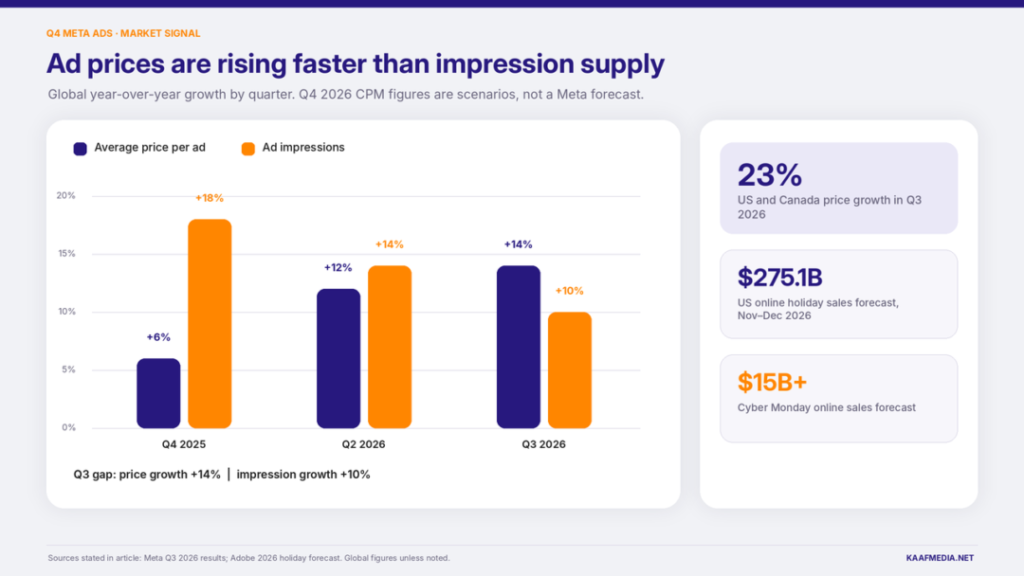
Meta’s price per ad rose 14% in Q3 while impression growth slowed to 10%.
You will also see claims that Q4 CPMs jump 20% to 50%, or 80% around Black Friday. Few of those posts name a source. We treat those numbers as planning scenarios, not forecasts, and the plan below is built to hold up at all three levels.
Is it the market or is it your account?
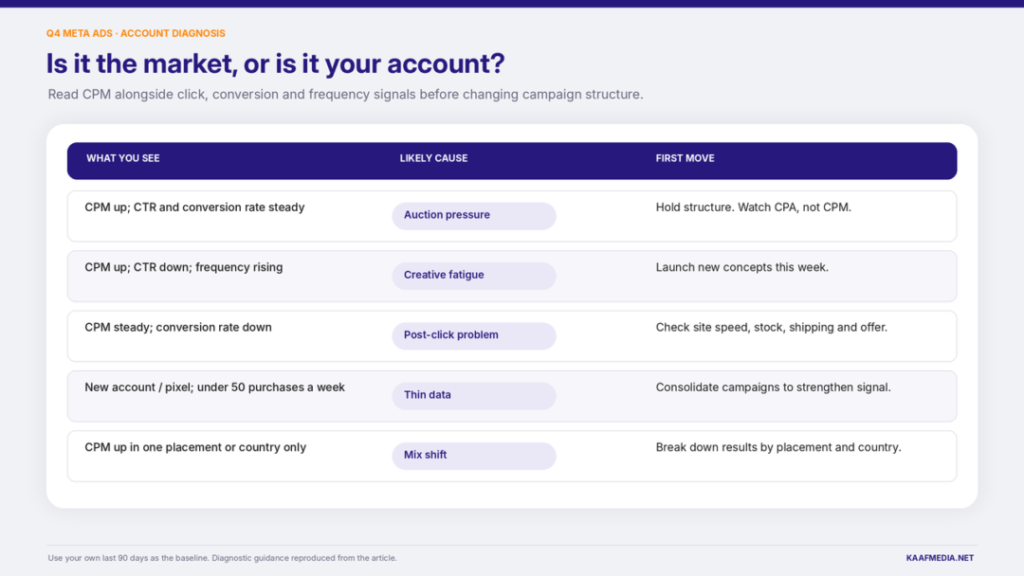
Compare today’s numbers with your own last 90 days, not with a platform average. If CPM is up while CPA, CTR and conversion rate hold steady, the auction is the cause and your account is fine. Use this table to read the other cases.
| What you see | Likely cause | First move |
|---|---|---|
| CPM up, CTR and conversion rate steady | Auction pressure | Hold your structure and watch CPA, not CPM. |
| CPM up, CTR down, frequency rising | Creative fatigue | Launch new concepts this week. |
| CPM steady, conversion rate down | Post-click problem | Check site speed, stock, shipping cost and offer. |
| New account, new pixel, or under 50 purchases a week | Thin data | Consolidate campaigns so each one gets more signal. |
| CPM up in one placement or country only | Mix shift | Break results down by placement and country before you change anything. |
Should you try to lower your CPM?
No. Judge ads on CPA and ROAS and let CPM float. In a Sweat Pants Agency study of US e-commerce brands, CPA was flat across the low, mid and high CPM thirds at $80.30, $79.30 and $78.90. The high-CPM third even converted best after the click, at 2.9% against 2.3%. That data covers video ads from 11 brands, uses Meta-attributed revenue, and compares ads within each account.
The reason is simple. Cheap CPMs usually come from broader, lower-intent inventory. You win the CPM line and lose the CPA line. One agency’s data is not a law, so check it against your own account before you act on it.
The goal is not a lower CPM. The goal is a CPA your margin can carry.
What is your break-even CPA and how does CPM change it?
Your break-even CPA is your average order value times your contribution margin before ads. Break-even ROAS is 1 divided by that margin. At a 55% contribution margin, break-even ROAS is about 1.82. We start every account review with this number, because it tells you which CPM levels you can afford.

The two formulas to keep. Break-even ROAS = 1 ÷ contribution margin. CPA = CPM ÷ (1,000 × CTR × conversion rate), with CTR and conversion rate written as decimals. At a $20 CPM, 1.5% CTR and 3% conversion rate, CPA is $44.44.
Take a store with a $90 average order and a 55% contribution margin. That leaves $49.50 per order to spend on ads. The table shows what happens to that store when CPM rises and nothing else changes.
| Scenario | CPM | CPA | ROAS | First-order profit | Order value needed to break even |
|---|---|---|---|---|---|
| Baseline | $20 | $44.44 | 2.03 | +$5.06 | $80.81 |
| CPM +20% | $24 | $53.33 | 1.69 | -$3.83 | $96.97 |
| CPM +50% | $30 | $66.67 | 1.35 | -$17.17 | $121.21 |
| CPM +80% | $36 | $80.00 | 1.13 | -$30.50 | $145.45 |
Example store. $90 average order, 55% contribution margin, 1.5% CTR, 3% conversion rate. Margin rate is assumed to hold as order value rises.
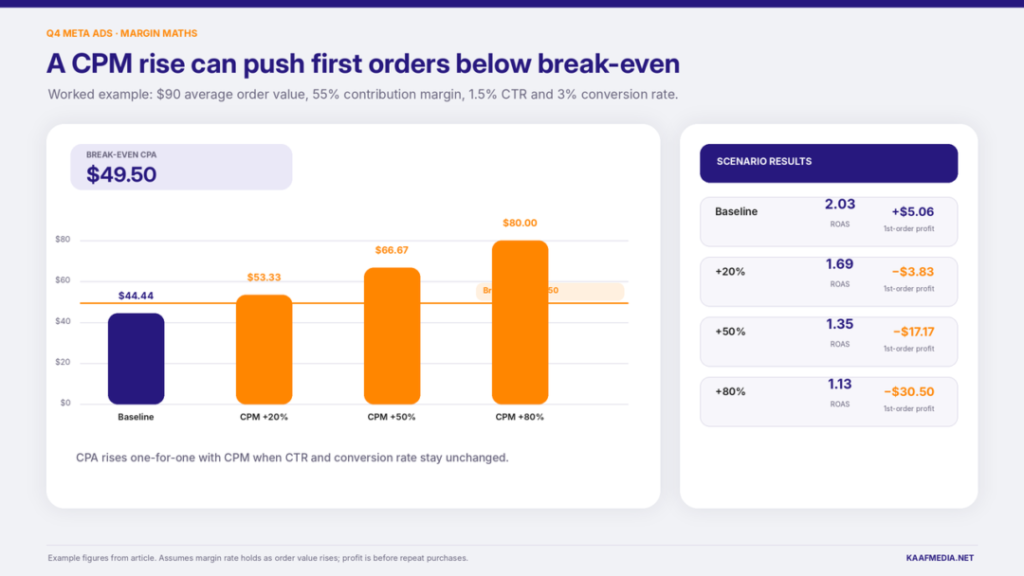
CPA moves one for one with CPM unless something else improves. Order value is the strongest lever. In the same agency data, average order value and post-click purchase rate tracked ROAS, while hook rate and CTR did not.
Be careful when you count on conversion rate to save you. Only 40% to 45% of a conversion-rate gain reached CPA in that study, because Meta reabsorbs the rest through higher click costs. Doubling conversion rate cut CPA by about 22%, not 50%. For target numbers by account type, see our Meta ads ROAS benchmarks for e-commerce.
What should you change at +20%, +50% and +80% CPM?
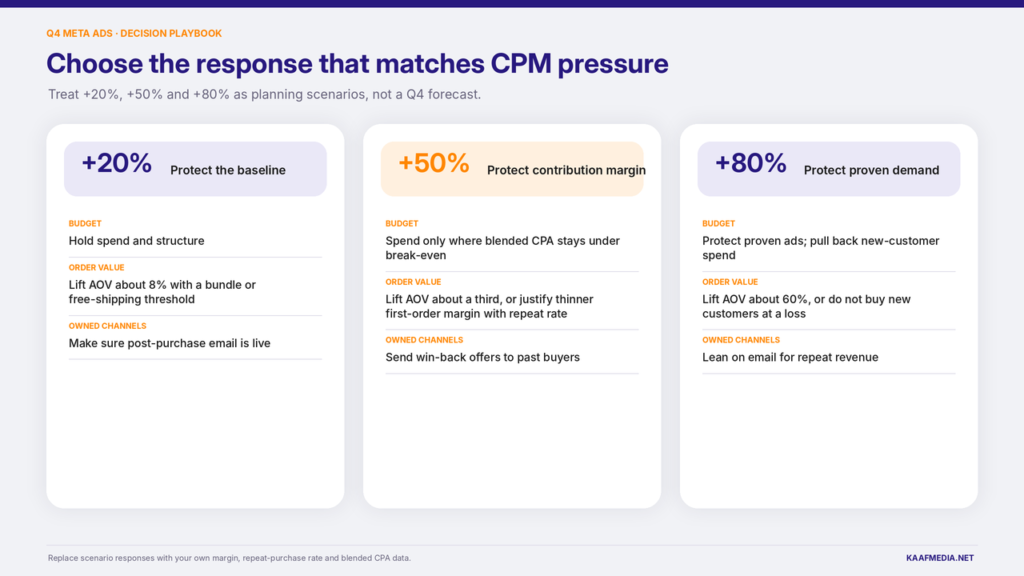
Match the response to the CPM level, and do not scale prospecting once first orders lose money without proof of repeat purchases. Use this matrix as a starting point and replace our example numbers with your own.
| CPM level | Main risk | Budget | Offer and order value | Owned channels |
|---|---|---|---|---|
| +20% | First orders slip below break-even | Hold spend and structure | Lift order value about 8% with a bundle or a free-shipping threshold | Make sure the post-purchase email flow is live |
| +50% | Paid first orders lose money | Spend only where blended CPA stays under break-even | Lift order value about a third, or accept thinner first-order margin only if repeat rate covers it | Send win-back offers to past buyers |
| +80% | Prospecting scale destroys margin | Protect proven ads and pull back on new-customer spend | Lift order value about 60%, or do not buy new customers at a loss | Lean on email for repeat revenue |
How should you pace budget through Black Friday and Cyber Monday?
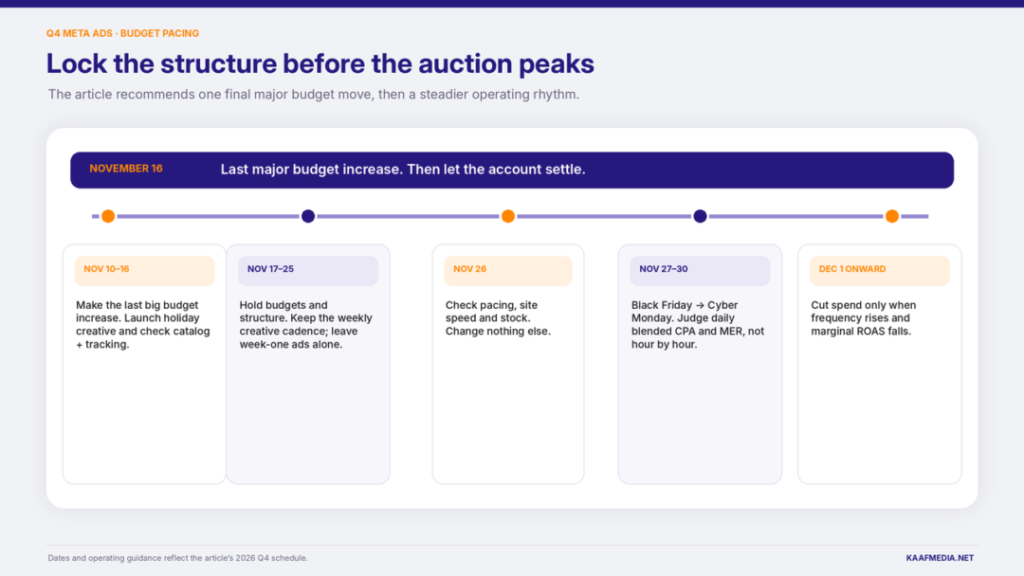
Make your last big budget move by November 16, then hold. In the same study, every budget increase added a 5% to 6% CAC penalty, whatever its size. A 10% increase cost about the same as a 50% one, and CAC took about 10 days to settle.
That cuts against the common advice to scale 20% every two or three days. We would make fewer, larger moves, budget the penalty into the plan, and give each move 10 days. If you have not restructured your campaigns yet, do not do it this week. A rebuild now stacks learning resets on top of the most expensive auctions of the year.
Make your last big budget move by November 16, then hold.
| Dates (2026) | What to do |
|---|---|
| Nov 10 to 16 | Make your last budget increase. Launch your holiday creative batch. Check that your catalog and tracking are clean. |
| Nov 17 to 25 | Hold budgets and structure. Keep launching new ads at your weekly pace and leave week-one ads alone. |
| Nov 26 (Thanksgiving) | Check pacing, site speed and stock. Change nothing else. |
| Nov 27 to 30 (Black Friday to Cyber Monday) | Judge results on daily blended CPA and MER (total revenue divided by total ad spend), not hour by hour. |
| Dec 1 onward | Cut spend only when frequency rises and marginal ROAS falls. Frequent big swings did not lower CAC in the study. |
Q4 budget shifts are funnel decisions. Our guide to full-funnel e-commerce advertising shows where each dollar should land across prospecting and retargeting.
How do you keep creative fresh when a few ads take most of the spend?
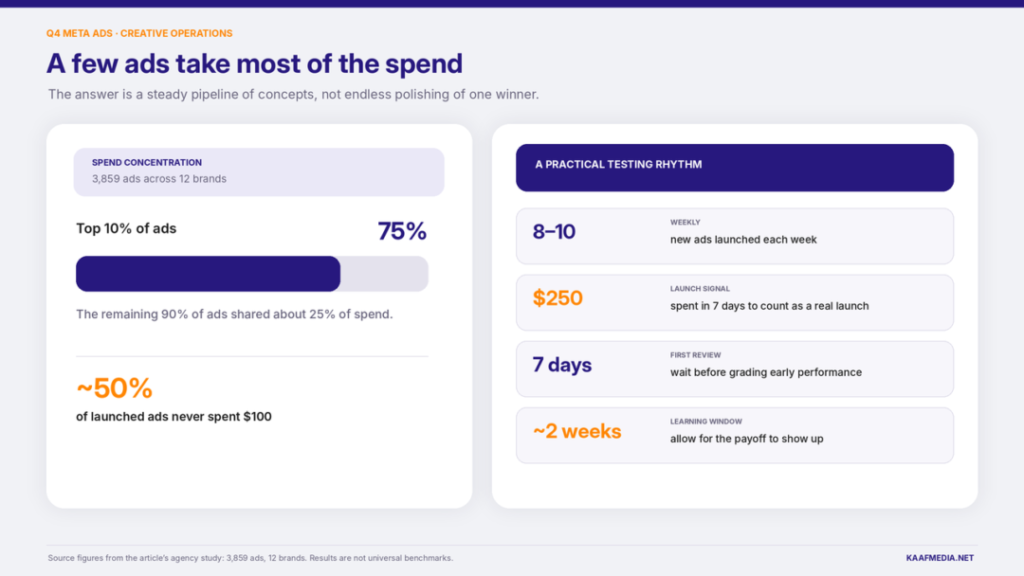
Plan for a few winners and many misses. Across 3,859 ads from 12 brands, the top 10% of ads took a median 75% of spend, and about half of all launched ads never spent $100. A steady supply of new concepts matters more than polishing each one.
| Rule | Number | Why it matters |
|---|---|---|
| Weekly launches | 8 to 10 new ads | Medium-volume weeks had the best same-week CAC. The payoff showed up about two weeks later. |
| What counts as a real launch | $250 spent in 7 days | Count ads that earn spend, not ads you uploaded. |
| When to judge | After day 7 | About 74% of ads still ran after a week and about 30% after a month. Day-one numbers mislead. |
| What to grade on | Post-click conversion rate and order value | Hook rate had almost no link to ROAS. |
| Format mix | Static and video | Where both ran at volume, static CPA landed within about 5% of video. |
| What to protect | Evergreen winners | Do not retire a profitable ad because it is old. |
Do not crown a winner too early. The ad that led in week one became the top ad in only 1 of 6 launch cohorts, so give a new batch about two weeks. If you cannot make 8 to 10 ads a week, make fewer, but keep the rhythm weekly.
How do you set up Advantage+ Sales for Q4?
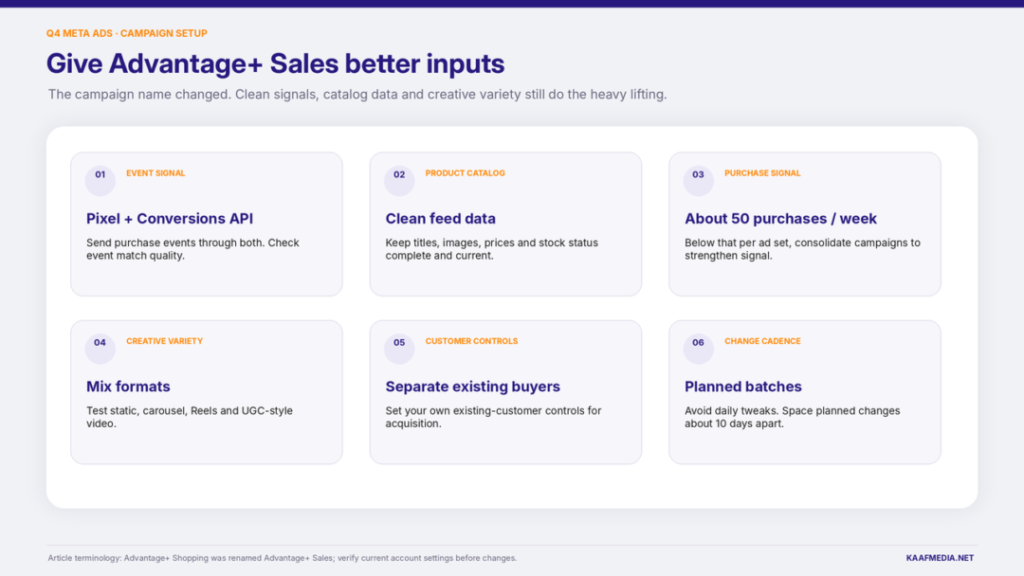
Treat Advantage+ as a system you feed, not a switch you flip. Meta renamed Advantage+ Shopping campaigns to Advantage+ Sales campaigns, and in most accounts the old shopping option has been replaced. Many Q4 guides still describe the legacy version. Run through this checklist before November 16.
- Send purchase events through both the pixel and the Conversions API, then check event match quality.
- Clean your product catalog. Titles, images, prices and stock status should be complete and current. Our guide to Google Shopping feed optimization covers the same hygiene.
- Aim for about 50 purchases a week per ad set. Below that, consolidate campaigns.
- Feed the system varied creative. Test static, carousel, Reels and UGC-style video.
- Set your own existing-customer controls, because the old existing-customer budget cap is gone from the new setup.
- Make changes in planned batches, not daily tweaks.
| Area | Default setup | Q4 setup |
|---|---|---|
| Event signal | Pixel only | Pixel plus Conversions API with checked match quality |
| Catalog | Imported as is | Clean titles, images, prices and availability |
| Creative | A few similar ads | Several concepts across static, carousel, Reels and UGC |
| Existing customers | Mixed in with new buyers | Controlled through your own audience settings |
| Budget changes | Daily tweaks | A few planned steps, 10 days apart |
| Success measure | Platform ROAS alone | Break-even CPA and blended MER |
We would not narrow placements or audiences in the middle of the peak. Starving the system of room tends to cost more than the CPM rise itself.
What does the rise in AI shopping traffic mean for paid costs?
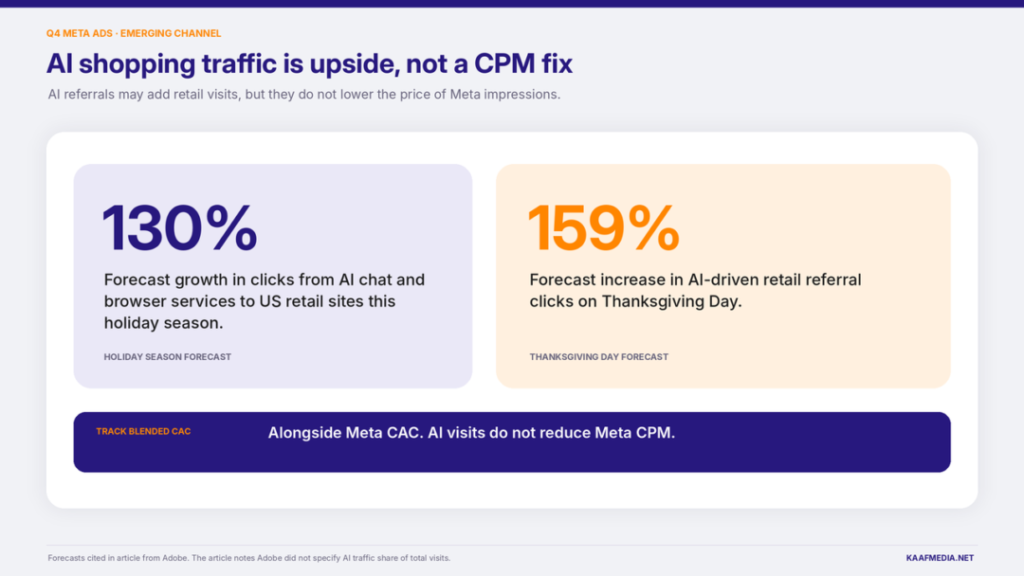
Treat AI traffic as upside, not as a plan. Adobe expects clicks from AI chat and browser services to US retail sites to rise 130% this holiday season, with the sharpest rise on Thanksgiving Day at 159%. That is a forecast, and Adobe does not say what share of total traffic it will be.
These visitors arrive without a Meta click, so they will not lower your CPM. In our view they can still lower your blended CAC if your product pages and feeds answer shopper questions clearly. Track blended CAC next to Meta CAC so you see the full picture.
How do owned channels protect margin when ad costs rise?
Email turns a break-even first order into a profitable customer. When a first order sits below break-even, repeat purchases pay the difference. Build your post-purchase and win-back flows before November 27, so every new Black Friday buyer gets a second offer. Our email marketing for e-commerce guide covers those flows in detail.
Meta ad cost questions e-commerce owners ask
What is a normal CPM for Meta ads?
There is no single normal number. CPM changes with niche, country, placement, season and account history. Compare it with your own 90-day baseline and judge it by the CPA it produces. A high CPM that converts costs less than a low CPM that does not.
Why is my Meta CPM so high right now?
Start with the diagnostic table above. Rising CPM with steady CPA points to the auction. Rising CPM with falling CTR points to tired creative. New accounts and new pixels often pay more while Meta learns who buys.
Is a ROAS of 4 good?
It depends on your margin. Break-even ROAS is 1 divided by contribution margin. A 55% margin breaks even at about 1.82, and a 25% margin breaks even at 4. A ROAS of 4 is profitable in the first case and break-even in the second.
Is a 2% CTR good for Meta ads?
CTR alone does not tell you. In the agency study, CTR had almost no link to ROAS, and people who click are often not the people who buy. Read it next to conversion rate and CPA.
Is Advantage+ Shopping still available?
In most accounts it now runs under the Advantage+ Sales name. Advantage+ stays on only while budget, audience and placements use Advantage+ settings, so check those before you change anything.
Final Thought
You cannot bid your way out of rising Meta ad costs. Meta’s prices are climbing faster than its ad supply, Black Friday demand is forecast at a record, and your break-even CPA stays where it is. Do these three things this week.
- Work out your break-even CPA and break-even ROAS from your contribution margin.
- Raise your average order value with bundles or a free-shipping threshold.
- Make your last big budget move by November 16, then hold your structure through Cyber Monday.
Stores that do this keep their margin in the most expensive quarter of the year. Stores that skip it pay for Meta’s price rise out of their own profit.