
Shoppers no longer browse endless category pages. They type questions like “linen shirt for a summer wedding under $60” or ask a chat window directly whether a product fits their needs. An AI shopping assistant for ecommerce is how your store answers those questions automatically, around the clock, without hiring a bigger support team. This guide covers the best AI shopping assistants for ecommerce stores in 2026, with free tiers, pricing in USD, and a simple framework for choosing between chat assistants, AI site search, and full answer engines.
Quick Summary:
Best free start: Shopify Search & Discovery (free on Shopify) plus Sidekick for store-side tasks.
Best AI chat assistant: Tidio Lyro, free up to 50 conversations per month.
Best AI site search for small and mid-size stores: Fast Simon or Doofinder.
Best for large catalogs: Klevu, Algolia, or Searchspring.
- Start free: Shopify’s own Search & Discovery app or Tidio Lyro’s free plan.
- Pick chat, search, or a full assistant based on where your shoppers get stuck.
- Test on real search queries and support tickets before paying.
- Keep a human review of answers during the first month.
What is an AI shopping assistant?
An AI shopping assistant is software that helps a shopper find the right product, get answers, and complete a purchase without a human agent. Most tools on the market fit into one of three types, and knowing which type you need is the fastest way to avoid paying for the wrong thing:
- Support chatbots answer repetitive questions about shipping, returns, sizing, and specs in a chat widget. Example: Tidio Lyro.
- AI site search replaces keyword search with natural-language, typo-tolerant, intent-aware results inside your search bar. Example: Klevu, Fast Simon, Doofinder.
- Full shopping assistants / answer engines combine search, chat, and product data to hold a conversation, recommend products, and answer questions with an answer engine that cites your own catalog. This is the fastest-growing category.
Why AI shopping assistants matter in 2026
The numbers moved fast this year. Salesforce’s 2026 holiday forecast, built on more than 1.5 billion shopper signals, expects AI chat agents to drive about one-fifth of global ecommerce traffic during the 2026 holiday season. Consumer demand is already there: Capital One Shopping’s 2026 research found that 76% of consumers want AI-powered shopping assistants, and that engagement with AI chat tools has been linked to conversion rates jumping from 3.1% to 12.3%.
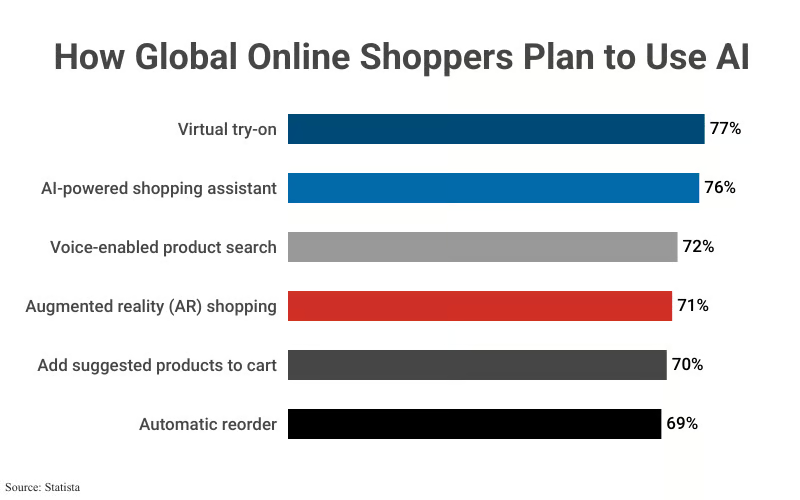
On-site search is the other half of the story. Baymard Institute research found that around 70% of ecommerce site searches cannot handle product-type synonyms, which means most stores lose shoppers to empty or irrelevant results before a chatbot is ever involved. Fixing search accuracy is usually cheaper and faster than adding another sales channel.
The best AI shopping assistants for ecommerce in 2026
These seven tools cover the full range: free platform-native search, chat assistants, mid-market AI search, and enterprise-grade semantic engines. They are ordered by how quickly a small store can get value, and every listing includes the free tier, the starting paid price in USD, and the platform each tool fits best.
- Shopify Search & Discovery + Sidekick (Free): Shopify’s own free app adds synonym groups, product recommendations, and semantic-style refinements to native search, while Sidekick handles store-side tasks in the admin. If you are on Shopify, install this before paying anyone. Open Search & Discovery.
- Tidio Lyro (Free up to 50 conversations/mo): The easiest AI support assistant for small stores. Lyro learns from your FAQ, policies, and product pages, then answers shopper questions in a chat widget across web, email, Messenger, Instagram, and WhatsApp. Paid plans start around $32/mo for higher conversation limits. Open Tidio.
- Fast Simon (Free plan available): AI search with personalization, upsell widgets, and collection sorting in one platform. The free tier covers around 100 sessions a month; paid tiers scale by sessions up to roughly $300/mo for larger stores. Open Fast Simon.
- Doofinder (from $49/mo, trial available): AI-powered search with a conversational assistant layer that answers shopper questions from your catalog on higher plans. Good fit for WooCommerce and other European platforms, with a 30-day trial to test before paying. Open Doofinder.
- Algolia (Free dev plan, usage-based after): Developer-friendly AI search API with a free tier (10,000 searches/month) and usage-based pricing, so cost grows with traffic. Best when you have dev resources and want full control over ranking. Open Algolia.
- Klevu (from ~$449/mo): Semantic natural-language search that understands vague or misspelled queries, plus AI merchandising. Built for stores with large catalogs and real search volume. Open Klevu.
- Searchspring (quote-based): Search plus merchandising with strong no-code control for growing brands; pricing is custom and typically starts in the mid hundreds per month. Open Searchspring.
AI shopping assistant pricing comparison
Here is the full cost picture side by side, so you can compare free tier limits and starting prices before you install anything. Tool names link to each provider’s official site, and prices were verified in November 2026.
| Tool | Type | Free tier | Paid from (USD) | Best for |
|---|---|---|---|---|
| Shopify Search & Discovery | AI search + refinements | Fully free | $0 | Any Shopify store |
| Tidio Lyro | Chat assistant | 50 conversations/mo | ~$32/mo | Support-heavy small stores |
| Fast Simon | AI search + personalization | ~100 sessions/mo | Tiers up to ~$300/mo | Growing Shopify stores |
| Doofinder | AI search + assistant | 30-day trial | $49/mo | WooCommerce, multilingual stores |
| Algolia | Search API | 10,000 searches/mo | Usage-based | Dev teams, custom storefronts |
| Klevu | Semantic search | No | ~$449/mo | Large catalogs |
| Searchspring | Search + merchandising | No | Custom (mid hundreds/mo) | Scaling brands |
How to choose the right AI shopping assistant
Start from where your shoppers get stuck, not from the feature list. If most questions arrive in chat and email, a chat assistant like Lyro pays for itself first. If shoppers search and leave with no results, AI search is the higher-return fix. Use this quick framework:
- On Shopify with a small budget: Search & Discovery (free) + Tidio Lyro free. Upgrade only the one that hits its limit.
- On WooCommerce or PrestaShop: Doofinder or Fast Simon.
- Thousands of SKUs and serious search volume: Klevu or Algolia.
- Need merchandising control as well as search: Searchspring.
- Custom storefront with dev resources: Algolia’s API.
Setup in five steps
Whichever tool you pick, the rollout follows the same five steps and usually takes an afternoon:
- Export your 50 most common support questions and 100 real search queries with no results.
- Install one tool from the list above and connect your catalog.
- Add synonyms and filter terms for your product types so vague searches return results.
- Point the assistant at your policies, FAQ, and shipping pages.
- Run for two weeks, review the transcript logs, then fix the answers that failed before scaling.
Mistakes to avoid
Before you install anything, here are the four mistakes that most often make store owners abandon an AI assistant within the first month:
- Buying enterprise search for a 200-product catalog. Free tiers and entry plans cover most stores under 5,000 SKUs.
- Letting the assistant invent answers. Always ground it in your own catalog and policy pages, and keep a human review of transcripts for the first month.
- Adding a chatbot while your search bar returns zero results. Fix search first; it touches every visitor.
- Ignoring transcript data. The failed questions are your next FAQ page, product description update, or navigation fix.
For the broader tool stack around visuals, copy, SEO, and email, see our complete guide to the best AI tools for ecommerce.
Frequently asked questions
These are the questions shoppers and store owners ask most about AI shopping assistants, answered with the free tiers and prices covered above.
What is the best AI tool for ecommerce automation that includes an answer engine?
For most stores, Tidio Lyro is the easiest answer engine to add, because it answers shopper questions from your own catalog and policies in a chat widget. Shopify stores should also enable the free Search & Discovery app so product questions resolve directly in search. Large catalogs get the best results from Klevu, which pairs semantic search with conversational answers.
Which AI search for ecommerce platform is worth replacing keyword search with?
If your native search returns zero results for natural-language or misspelled queries, Fast Simon or Doofinder is worth it for small and mid-size stores, since both start under $50/mo with trials or free tiers. For large catalogs, Klevu justifies its higher price because it understands vague, conversational queries that keyword search misses.
Where can I start a trial of AI search for ecommerce software?
Doofinder offers a 30-day trial, Tidio Lyro has a permanent free plan of 50 conversations per month, Fast Simon has a free tier of around 100 sessions, and Algolia includes 10,000 searches per month on its free plan. Shopify’s Search & Discovery app is free forever for Shopify stores.
How do I build an AI shopping assistant for my ecommerce site?
You do not need to build one from scratch. Install an existing assistant (Tidio Lyro for chat, Fast Simon or Doofinder for search), connect your product catalog, add your policies and FAQ as knowledge sources, define synonyms for your product types, then review transcripts for two weeks and fix the failed answers before scaling.
Are hosted AI search tools worth paying for?
They are worth paying for when search drives a meaningful share of your revenue: shoppers who use site search convert at several times the rate of browsers, and AI search recovers the queries keyword search drops. If your catalog is small and your native search already handles synonyms well, stay on free tiers first and upgrade when a proven workflow hits its limit.
What are the best AI solutions for improving search accuracy in ecommerce?
Start with synonyms and product-type filters inside your platform’s free tools, then add semantic search (Klevu or Algolia) if queries are still failing. The accuracy gain comes mostly from clean, structured product data: consistent titles, attributes, and descriptions give any AI search better raw material than any single tool feature.
What AI tools give 24/7 support and productivity for an online store?
Tidio Lyro answers questions around the clock on the free plan, Shopify Inbox routes what it cannot answer, and the free tiers of Fast Simon and Doofinder keep search accurate overnight. Combined, they cover most of the repetitive questions a small store receives without night shifts.
Where Kaaf Media Network fits in
An assistant answers questions; a growth system decides which questions deserve answers. Kaaf Media Network helps US ecommerce brands connect AI shopping assistants, SEO, email, and full-funnel advertising into one workflow that moves revenue, with proper analytics and reporting to prove it.
The assistant that wins is not the smartest one. It is the one grounded in your own product data, reviewed by people who know the brand.
Want a partner who can audit your store’s search and support gaps before you spend on software? Plan Your Ecommerce Growth with Kaaf Media Network.
Final recommendation

Start with the free layer (Shopify Search & Discovery, Tidio Lyro free, or an Algolia dev plan), fix the search queries that return nothing, and only pay for AI search when a proven workflow outgrows the free tier. Ground every assistant in your own catalog, review transcripts for the first month, and let the failed questions tell you what to publish next.