
Quick Summary:
GCC ecommerce is growing, but public market-size and CPM numbers often measure different things. This playbook focuses on what decides profit in 2026: choosing the right Gulf market, modelling COD and BNPL margin, tracking confirmed revenue, testing Arabic creative and pacing spend around seasonal demand. Use external benchmarks as planning ranges, then replace them with your own account data.
- Start with one market, one offer and one clean measurement system before expanding across the GCC.
- Treat CPM benchmarks as directional estimates, not guaranteed acquisition costs.
- Model COD failure, returns, confirmation costs and BNPL fees before setting a ROAS target.
- Do not build a 2026 plan around an unconfirmed TikTok Shop launch in the UAE or Saudi Arabia.
- Use Arabic as a structured creative and dialect test, not simple translation.
What Scales Ecommerce Marketing in the GCC in 2026
Ecommerce marketing in the GCC scales when you plan for contribution margin, not just traffic. In 2026, the brands that grow most predictably will choose one priority market, understand COD and BNPL economics, measure confirmed revenue rather than platform-reported conversions, and adapt creative to local Arabic and English behaviour.
GCC here means the Gulf Cooperation Council: the UAE, Saudi Arabia, Kuwait, Qatar, Bahrain and Oman. It does not mean Global Capability Centers.
| Priority | What to do first | Why it matters |
|---|---|---|
| Market | Choose the UAE, Saudi Arabia or a smaller Gulf market based on AOV, COD tolerance and language | CPMs, payments and logistics differ by country |
| Margin | Calculate contribution margin after COD failure, returns and payment fees | A winning ad can still lose money after fulfilment |
| Measurement | Send confirmed or delivered orders to ad platforms, not raw checkout events | COD orders can inflate reported performance |
| Creative | Test native Gulf Arabic, Modern Standard Arabic and English hooks | Translation alone rarely captures local buying language |
| Calendar | Plan spend around Ramadan, White Friday, National Days and salary cycles | Auction pressure and demand rise in peak windows |
GCC Ecommerce Market Size 2026: Why Estimates Differ by 8x
GCC ecommerce is growing, but the market-size numbers you see online are not always measuring the same thing. Some reports count consumer retail only. Others include business-to-business, consumer-to-consumer and other transaction types.
That is why IMARC Group values the GCC ecommerce market at USD 584.8 billion for 2025, while country-level consumer ecommerce estimates are much smaller. IMARC’s report includes B2B, B2C, C2C and other transaction categories, so use it for broad regional context rather than as a direct benchmark for a DTC store.
For practical planning, country estimates are more useful. Mordor Intelligence estimates Saudi Arabia’s ecommerce market at USD 31.29 billion in 2026, while its UAE estimate stands at USD 12.30 billion for 2026. These numbers help you compare opportunity, but they cannot replace your own AOV, return-rate and contribution-margin data.
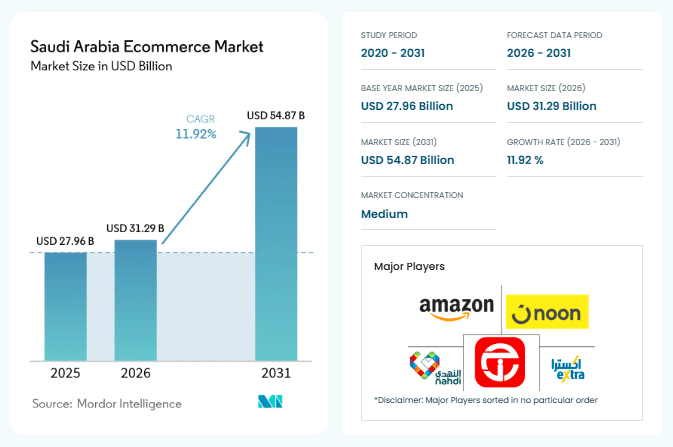
The strongest near-term Saudi signal comes from payments data. According to the Saudi Central Bank’s monthly bulletin, reported by Saudi Gazette, mada ecommerce sales reached SR37.6 billion in July 2026. That was 26% higher year on year and 11.8% higher than June 2026.
| Claim | Source | How to use it |
|---|---|---|
| GCC ecommerce market: USD 584.8B in 2025 | IMARC Group | Broad regional context; includes B2B, B2C and C2C transactions |
| Saudi ecommerce: USD 31.29B in 2026 | Mordor Intelligence | Country-level market sizing |
| UAE ecommerce: USD 12.30B in 2026 | Mordor Intelligence | Country-level market sizing |
| Saudi mada ecommerce sales: SR37.6B in July 2026 | Saudi Gazette reporting SAMA data | Near-term Saudi digital-payment demand signal |
Which GCC market size estimate should you plan with?
- Use SAMA mada data to understand Saudi online payment momentum.
- Use Mordor country estimates for market prioritisation.
- Use your own 90-day revenue, AOV and return data for media targets.
- Use agency CPM and ROAS claims only as starting hypotheses.
Which GCC Market to Launch First: UAE, Saudi Arabia or the Rest of the Gulf
The best first market is not always the biggest one. It is the market where your product, price point, fulfilment setup and payment mix can produce repeatable contribution margin.
UAE
The UAE is often the easiest first test market for cross-border and DTC brands. English works well, logistics are mature, card payments and digital wallets are widely used, and the market supports higher-AOV products. Mordor Intelligence estimates UAE ecommerce at USD 12.30 billion in 2026, making it a substantial but more manageable first market than Saudi Arabia for many brands.
Saudi Arabia
Saudi Arabia offers the largest consumer opportunity, but it demands stronger localisation. Arabic creative, local trust signals, mada support, delivery expectations and COD risk all matter more here. The latest SAMA-based reporting shows that mada ecommerce sales reached SR37.6 billion in July 2026, up 26% year on year, which supports continued growth in digital payments.
Kuwait, Qatar, Bahrain and Oman
These markets can work well when your product has a clear niche, strong AOV or low fulfilment complexity. They are smaller than the UAE and Saudi Arabia, but competition and CPM pressure can also be lower. Test them after you have a proven creative, offer and fulfilment flow in your primary market.
| Market | Best fit | Main watch-out |
|---|---|---|
| UAE | Higher AOV, English-friendly and fast cross-border testing | Competitive auction and rising acquisition costs |
| Saudi Arabia | Arabic-first offers, local fulfilment and a COD plus prepaid mix | COD failure, returns and trust barriers |
| Kuwait | Niche premium products and Arabic-English mixed campaigns | Smaller audience pool |
| Qatar | Premium and lifestyle categories | Market size and delivery coverage |
| Bahrain | Low-risk regional expansion | Limited scale |
| Oman | Selective category expansion | Logistics and payment coverage |
If you run several markets from one store, separate campaigns by country, currency, language and delivery promise. A single GCC campaign usually hides which market is profitable.
TikTok Shop UAE and Saudi Arabia: Current Status and What Sellers Should Do
TikTok Shop is one of the most misreported topics in GCC ecommerce. Some articles describe it as live in the UAE or Saudi Arabia, but current seller-access checks and TikTok’s published regional availability do not support that position.
As of October 2026, industry checks report no UAE Seller Center, local checkout or official UAE launch date. The same issue applies to Saudi Arabia. Saudi Arabia does not appear on TikTok’s published list of TikTok Shop regions, which means there is no confirmed local seller-registration route.
Reports of a possible Saudi launch in early 2027 exist, but they remain unconfirmed. Until TikTok officially adds the UAE or Saudi Arabia to its seller regions, plan around TikTok Ads, Spark Ads, creator partnerships and cross-border selling where eligible.
| Question | Current practical answer | What to do now |
|---|---|---|
| Is TikTok Shop live in the UAE? | No confirmed local Seller Center or local checkout | Run TikTok Ads and creator-led campaigns |
| Is TikTok Shop live in Saudi Arabia? | No confirmed local Seller Center; launch rumours remain unverified | Prepare feeds, compliance and creative, but do not depend on Shop |
| Can Gulf brands still use TikTok? | Yes | Use paid TikTok, UGC and retargeting |
| Should you wait for TikTok Shop? | No | Build demand and creative assets now |

For a deeper measurement workflow, see Kaaf Media’s guide to TikTok and Google Ads attribution. It is especially useful if you run TikTok and Google campaigns in parallel for UAE ecommerce.
Paid Social CPM Gulf 2026: Meta, TikTok and Snapchat Benchmarks
Most Gulf CPM articles publish one number. That is misleading. The same country can show very different CPMs depending on audience, objective, placement, creative quality, season and account history.
For example, Lebesgue reports a USD 12.01 median Facebook CPM for Saudi ecommerce in 2026. Other Gulf-focused agencies publish wider ranges. Treat all of these as directional inputs, not fixed prices.
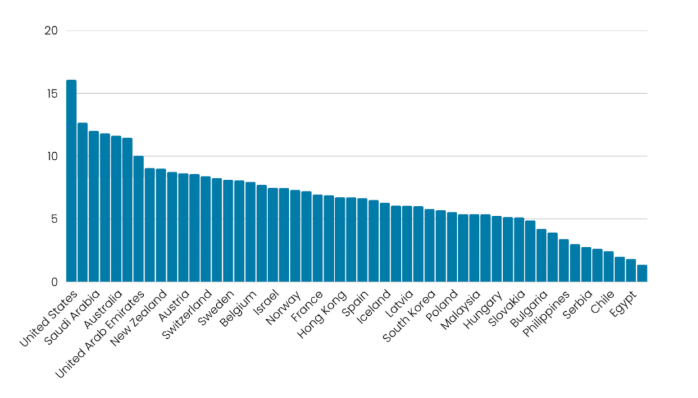
Platform-level data also shows why TikTok deserves a structured test. In Triple Whale’s benchmark dataset covering August 2025 to July 2026, the median TikTok CPM was USD 4.08 across more than 5,900 brands, compared with a USD 15.06 Meta median across more than 40,000 ecommerce brands. That does not guarantee cheaper Gulf acquisition costs, but it makes TikTok a logical channel to test against Meta.
| Channel and market | Published range or median | Source type | Planning use |
|---|---|---|---|
| Meta CPM, Saudi Arabia | USD 12.01 median; other sources cite USD 8 to 15 | Vendor and agency benchmarks | Set an initial test budget, not a performance promise |
| Meta CPM, UAE | Roughly USD 6 to 14, depending on source | Vendor and agency benchmarks | Use as a directional auction-cost estimate |
| TikTok CPM, Saudi Arabia | SAR 4.50 to 9.00, roughly USD 1.20 to 2.40 | Agency benchmark | Test upper- and mid-funnel creative |
| TikTok CPM, global | USD 4.08 median, Aug 2025 to Jul 2026 | Large platform panel | Useful context, not a Gulf guarantee |
| Snapchat, Saudi Arabia | SAR 6 to 18, agency-reported | Agency benchmark | Test strongly for KSA youth and local reach |
How to build your own paid social CPM baseline
- Run each platform for at least 14 days with a consistent objective and audience structure.
- Separate prospecting, retargeting and creator-style campaigns.
- Record CPM, CTR, hook rate, cost per initiated checkout, confirmed purchase rate and blended CAC.
- Compare platform-reported purchases with store revenue.
- Rebuild your benchmark every quarter, especially after Ramadan and White Friday.
Snapchat remains especially relevant in Saudi Arabia. Snap has reported more than 26 million monthly users in the Kingdom, with strong reach among younger Saudis. Treat company-reported reach as audience potential, not unique-person reach. Snapchat Saudi Arabia audience report
Noon, Amazon.ae or Your Own Store: Where to Spend Digital Advertising in the Gulf
Marketplaces and your own store solve different problems. Marketplaces bring existing demand and trust. Your own store gives you customer data, creative control, retention and higher long-term margin potential.
| Channel | Best for | Main limitation |
|---|---|---|
| Noon | GCC-native demand, regional visibility and marketplace shoppers | Less customer ownership and pricing control |
| Amazon.ae | High-intent UAE shoppers and established product categories | Marketplace fees and limited first-party data |
| Your own Shopify, Salla or Zid store | Brand building, retention, email and WhatsApp marketing, and margin control | You must create demand and trust yourself |
| Google Search and Shopping | Capturing existing product and category demand | Less effective for unknown products without search volume |
A practical budget split for many growing GCC brands is to use marketplaces for demand capture, Google for high-intent search, and Meta, TikTok or Snapchat for demand creation. The exact split should follow contribution margin, not platform preference.
If you sell through Salla, Zid or Shopify, confirm that your pixel, server-side events, product feed and checkout events work before increasing spend. Platform tracking gaps can make an unprofitable campaign look successful. AdGrow’s Salla, Zid and Shopify paid ads guide explains why the gap between platform-reported and store-confirmed revenue deserves regular review.
COD vs BNPL vs Prepaid: Margin Math for GCC Ecommerce Stores
Cash on delivery can unlock demand in the Gulf, especially in Saudi Arabia. It can also quietly destroy margin when failed deliveries, returns and confirmation costs are not modelled.
A Gulf COD fulfilment operator estimates that unconfirmed COD shipments fail 25 to 45% of the time, depending on product category and traffic source. This is a vendor-reported range, not an audited industry dataset, so replace it with your own confirmation and delivery data as soon as possible.
BNPL fees also reduce contribution margin. Third-party payment guides commonly report Tabby merchant fees at 3.5 to 5% and Tamara fees at 3 to 4.5%, but both providers set pricing by contract. Confirm your actual rate with your payment provider before using these numbers in a profit model.
Worked example: UAE prepaid order
- Selling price: AED 300
- Product and fulfilment cost: AED 120
- Delivery cost: AED 25
- Payment fee at 3%: AED 9
- Returns allowance at 8%: AED 24
- Contribution before ads: AED 122
If your target contribution margin before ads is AED 60, your maximum allowable acquisition cost is AED 62. That is your real break-even CPA, not a platform-reported ROAS target.
Worked example: Saudi COD order
- Selling price: SAR 300
- Product and fulfilment cost: SAR 120
- Delivery cost: SAR 30
- COD handling and confirmation cost: SAR 20
- Expected COD failure and return loss at 30%: SAR 51
- Contribution before ads: SAR 79
In this example, a 30% COD failure assumption removes a large part of the margin before advertising begins. If your actual COD failure rate is 40%, the same offer may need a higher price, prepaid incentives, better confirmation or a different product.
A high-margin product with heavy COD failure can be less profitable than a lower-margin product with strong delivery confirmation.
How to Track COD Orders in Meta, TikTok and Snapchat Ads
COD creates a measurement problem. The checkout event may fire, but the order may never be confirmed, delivered or paid. If your ad platform learns from unqualified COD events, it can optimise toward buyers who never complete the purchase.
Which event should you send?
- Send InitiateCheckout only for funnel analysis.
- Send Purchase only after order confirmation for COD.
- Consider a separate Delivered or Confirmed Revenue event for long-term optimisation.
- Use server-side tracking where possible to reduce browser and consent-related loss.
- Reconcile platform purchases against store orders weekly.
A practical rule used by practitioners is to investigate when platform-reported conversions exceed store-confirmed revenue by more than 50%. A smaller gap can be normal because of attribution windows, view-through conversions and delayed reporting. AdGrow’s tracking guidance for Salla, Zid and Shopify recommends treating a large platform-versus-store gap as a signal-quality problem.
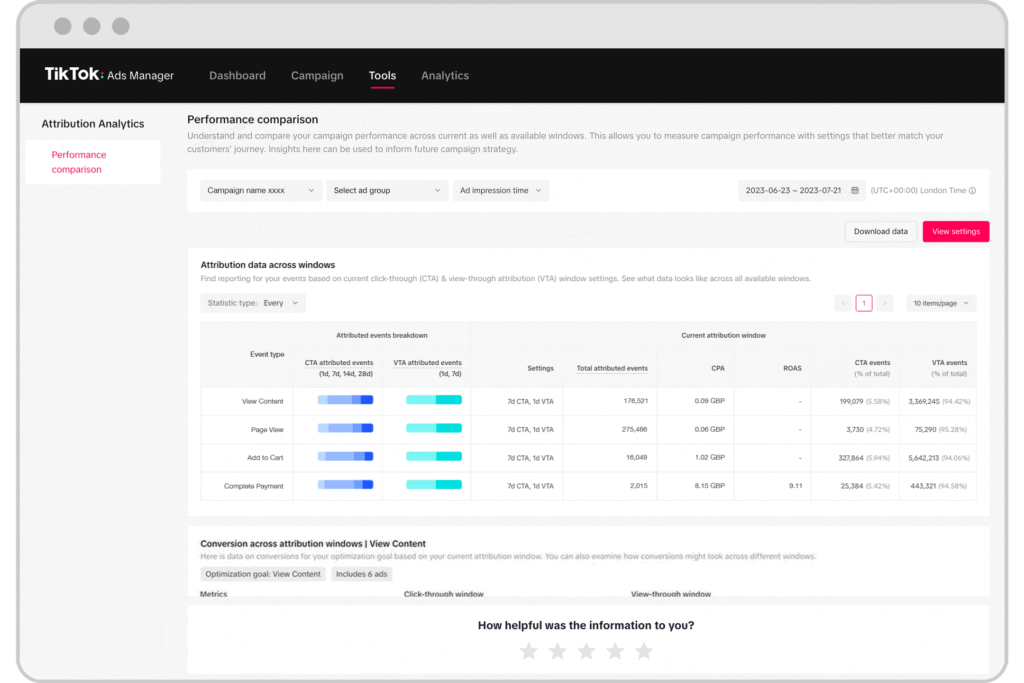
TikTok also provides attribution and performance-comparison tools that help advertisers understand measurement differences across attribution settings. Use them to diagnose signal quality, not to justify inflated ROAS. TikTok’s Attribution Analytics documentation
Arabic Ecommerce Content Strategy: Dialect, Search and Creative Testing
Arabic localisation is not just translation. Saudi, Emirati, Kuwaiti and wider Gulf audiences respond to different phrasing, cultural references, formality levels and creator styles.
Many articles quote large Arabic-conversion uplifts, but few provide a reliable primary study. A more defensible global finding comes from CSA Research, which found that 76% of consumers prefer buying products with information in their own language, and 40% never buy from websites in other languages. That is not GCC-specific, but it supports the case for serious localisation. CSA Research findings via Kreative Clan
Khaleeji vs Modern Standard Arabic
| Asset | Recommended Arabic approach | Why |
|---|---|---|
| Video ads and UGC | Khaleeji or country-specific dialect | Feels native and conversational |
| Landing pages | Clear Modern Standard Arabic with localised product terms | Improves clarity and trust |
| Google Search ads | Test Modern Standard Arabic and local search phrasing | Search queries vary by market |
| WhatsApp and SMS | Short, conversational Gulf Arabic | Matches how customers already communicate |
| Product descriptions | Native review by a local speaker | Prevents awkward machine translation |
How to run an arabic creative test for GCC ads
- Create one English hook, one Modern Standard Arabic hook and one native Khaleeji hook for the same offer.
- Keep the visual, offer and landing page consistent.
- Run each version with the same budget for at least 3 to 5 days.
- Judge hook rate, CTR, cost per confirmed purchase and return rate.
- Have a native speaker review dialect, tone, product names and cultural references.
AI can help with first drafts, but it often blends Arabic registers or misses local nuance. Keep a native reviewer in the workflow for ads, landing pages and customer-facing messages.
Ramadan, White Friday and Payday Budget Planning for GCC Ecommerce
GCC demand is seasonal, but many brands only raise budgets after CPMs have already increased. A better approach is to prepare creative, inventory, offers and budget pacing before the auction becomes expensive.
| Period | What changes | Planning action |
|---|---|---|
| Ramadan | Higher engagement and CPM pressure; one agency estimate puts CPM inflation around +68% | Prepare creative early and increase budget gradually |
| White Friday | Strong discount-driven demand; agency estimates cite +40 to 65% CPM increases in the UAE and +50 to 80% in Saudi Arabia | Protect margin and avoid discount-led losses |
| Saudi National Day | Local cultural demand and creative opportunities | Use Saudi-specific offers and creator content |
| UAE National Day, Dec 2 to 3 | Seasonal demand and patriotic creative angles | Plan offers and delivery cut-offs early |
| Salary cycles | Spending power often rises after payday | Adjust pacing and retargeting windows around pay dates |
These percentage increases are agency estimates, not universal rules. Use them to plan budget scenarios, then compare them with your own CPM and conversion data. BIMO’s Gulf Meta benchmarks and 23HubLab’s GCC Meta benchmark analysis both publish Gulf-specific seasonality observations.
For budget pacing, avoid turning everything on at once. Increase spend in steps, protect your best-performing audiences, and keep a reserve for retargeting during peak days.
Ecommerce Ad Compliance in Saudi Arabia and the GCC
Compliance is not separate from performance marketing. In Saudi Arabia, undisclosed advertising, misleading claims and fake offers can create legal and platform risk.
Saudi Arabia’s Commerce Ministry has referred social-media advertisers to investigation over alleged violations of the E-Commerce System, including fake goods, false claims and undisclosed advertising. It has also taken action against websites marketing fake goods to Saudi shoppers. Gulf News Saudi enforcement report and Gulf News fake-goods enforcement report
Practical compliance checklist
- Disclose paid partnerships and creator collaborations clearly.
- Avoid unsupported health, financial or product claims.
- Confirm product standards and certification requirements before promoting regulated goods.
- Display VAT, delivery, return and refund information clearly.
- Collect consent for marketing messages and personal-data use.
- Keep proof of product claims, supplier agreements and ad approvals.
Saudi Arabia’s personal data protection law is commonly referred to as the PDPL. Before making data-localisation or enforcement claims, confirm the current requirements with official Saudi regulatory sources.
AI Personalization for GCC Ecommerce Without Losing Local Cultural Touch
AI is useful for speed, not judgement. It can help you produce creative variations, analyse ad comments, draft product copy and summarise performance. It should not decide your offer, margin model or market strategy.
- Use AI for hook variations, brief creation, translation drafts and reporting summaries.
- Use humans for Arabic dialect review, brand voice, offer design and compliance checks.
- Use automated bidding only after conversion signals are clean and consistent.
- Do not scale AI-generated creative until it has beaten a control.
For a practical tool shortlist, see Kaaf Media’s guide to the best AI tools for ecommerce.
90-Day GCC Ecommerce Scale Plan by Revenue Stage
Scaling in the GCC becomes easier when each phase has one clear job. Do not try to fix tracking, creative, market selection and retention at the same time.
| Phase | Focus | Gate to move forward |
|---|---|---|
| Days 1 to 30 | Fix measurement, payment mix, COD workflow and market selection | Store revenue and platform conversions are reconcilable |
| Days 31 to 60 | Test offers, Arabic and English creative, creators and landing pages | At least one repeatable profitable creative and audience pattern |
| Days 61 to 90 | Scale budgets, expand markets and build retention | Contribution margin remains positive as spend increases |
Days 1 to 30: Fix Measurement and Margin
- Separate campaigns by country and language.
- Set up confirmed-purchase tracking for COD.
- Calculate contribution margin by payment method.
- Build a 14-day CPM and CPA baseline.
- Choose one primary market and one secondary test market.
Days 31 to 60: Test Creative, Offers and Payments
- Test native Arabic, Modern Standard Arabic and English creative.
- Test creator-led UGC against studio-style ads.
- Test prepaid incentives against COD.
- Test landing pages, bundles and delivery promises.
- Pause offers that cannot survive return and COD failure assumptions.
Days 61 to 90: Scale Budgets and Expand Markets
- Increase budgets in controlled steps.
- Expand into one additional GCC market only after the first market is stable.
- Add WhatsApp, email or CRM-based retention flows.
- Prepare seasonal creative before Ramadan and White Friday.
- Review compliance, product claims and creator disclosures.
If you need help turning this into an execution plan, Kaaf Media’s digital advertising services cover paid social, search, marketplace and measurement support.
Frequently Asked Questions:
These are the questions GCC ecommerce owners ask most often before committing budget to a new market, channel or payment method.
Which digital marketing channels are driving the highest ROI in Saudi Arabia vs. the UAE?
There is no single highest-ROI channel for the whole GCC. In the UAE, Google Search, Shopping and marketplace ads often capture existing demand efficiently, while Meta works well for demand creation and retargeting. In Saudi Arabia, TikTok and Snapchat can be strong discovery channels, especially for fashion, beauty and youth-focused products, while Meta and Google help convert existing interest.
The right allocation depends on your contribution margin, AOV, COD exposure and fulfilment capacity. Start by separating prospecting, retargeting and high-intent search campaigns. Then judge each channel on confirmed revenue and contribution margin, not platform-reported ROAS.
Retail media on Noon and Amazon can convert well because it reaches shoppers closer to purchase intent. However, marketplace ads usually give you less first-party customer data and less control over retention. Use them to capture demand, then use your own store, WhatsApp and email flows to build repeat revenue.
How are brands successfully implementing AI personalization without losing the local cultural touch?
The strongest use of AI in GCC ecommerce is operational, not cultural. Brands can use AI for product recommendations, demand forecasting, creative variations, translation drafts and performance reporting. These tasks benefit from speed and scale.
But local trust still needs human judgement. Arabic dialect, religious and seasonal context, creator selection, humour, product claims and Ramadan or Eid messaging should be reviewed by people who understand the market.
A practical workflow is to let AI produce first drafts and variations, then have a native Arabic reviewer approve dialect, tone and cultural references. Use AI to create more options. Use humans to decide what represents your brand.
What role do BNPL platforms play in e-commerce marketing strategy for 2026?
BNPL platforms such as Tabby and Tamara can reduce checkout friction and make higher-priced products feel more affordable. For many GCC stores, they are worth testing as a conversion and AOV lever, particularly for fashion, electronics, beauty and home categories.
They are not free money, though. Merchant fees reduce contribution margin, and BNPL should not replace a clear pricing and returns strategy. Before promoting instalments in ads, calculate the fee impact on your break-even CPA and confirm the exact rate in your merchant agreement.
A good test is to show BNPL only where it improves completed purchases without attracting customers who later return products. Track AOV, return rate, payment failure and contribution margin by payment method.
What is the impact of social commerce and livestream shopping in the GCC?
Social commerce is already important in the GCC because discovery, trust and purchase often happen inside social platforms. Creator content, UGC, WhatsApp conversations and short-form video can move customers from awareness to purchase faster than a standard product page.
Livestream shopping is still developing, and its impact varies by category and market. It tends to work best when the host has real product expertise, the offer is clear and viewers can buy without friction.
For now, most GCC brands should treat livestream shopping as a test channel, not a core dependency. Build a repeatable creator and UGC workflow first. That gives you assets you can use across TikTok, Meta, Snapchat and future social-commerce features.
What are the biggest logistical barriers impacting e-commerce marketing success?
The biggest barrier is treating marketing and operations as separate functions. A strong ad can bring orders, but late delivery, poor confirmation, high COD failure or unclear returns will damage both margin and repeat purchase rate.
COD is the clearest example. Unconfirmed orders, failed deliveries and returns can make a campaign look successful in the ad platform while the store loses money. Brands should track confirmation rate, delivery rate, return reason and contribution margin by campaign.
Before scaling ads, confirm delivery coverage, return handling, customer-service response time and stock availability. In the GCC, a reliable post-purchase experience is part of the marketing system, not an operational afterthought.
Sources, Methodology and Last Updated for This GCC Ecommerce Guide
This article uses external estimates where first-party GCC data is unavailable. Benchmarks come from vendor, agency and research sources, so treat them as planning ranges. The strongest data points are central-bank figures, peer-reviewed studies and platform documentation.
| Source | Type | Used for |
|---|---|---|
| Saudi Gazette reporting SAMA data | Central-bank data via news report | Saudi mada ecommerce sales |
| Mordor Intelligence | Market research | Saudi ecommerce market estimate |
| Mordor Intelligence | Market research | UAE ecommerce market estimate |
| IMARC Group | Market research | Broad GCC market-size context, including B2B and C2C transactions |
| Lebesgue | Vendor benchmark | Saudi Meta CPM median |
| Triple Whale | Platform panel benchmark | TikTok and Meta CPM context |
| MyZambeel | COD fulfilment vendor | COD failure-rate range |
| Truescho | Payment guide | Commonly reported Tabby and Tamara fee ranges |
| Frontiers in Communication | Peer-reviewed study | Influencer trust and purchase intent |
| Z Media and Lilach Bullock | Independent status checks | TikTok Shop UAE and Saudi availability |
| TikTok for Business | Platform documentation | Attribution measurement |
Last updated: October 19, 2026. TikTok Shop availability, CPM benchmarks and regulatory enforcement should be rechecked before major budget decisions.